A General Overview of Coups in Türkiye on the 10th Anniversary of July 15 Program Held
Tarih: 14 Temmuz 2026
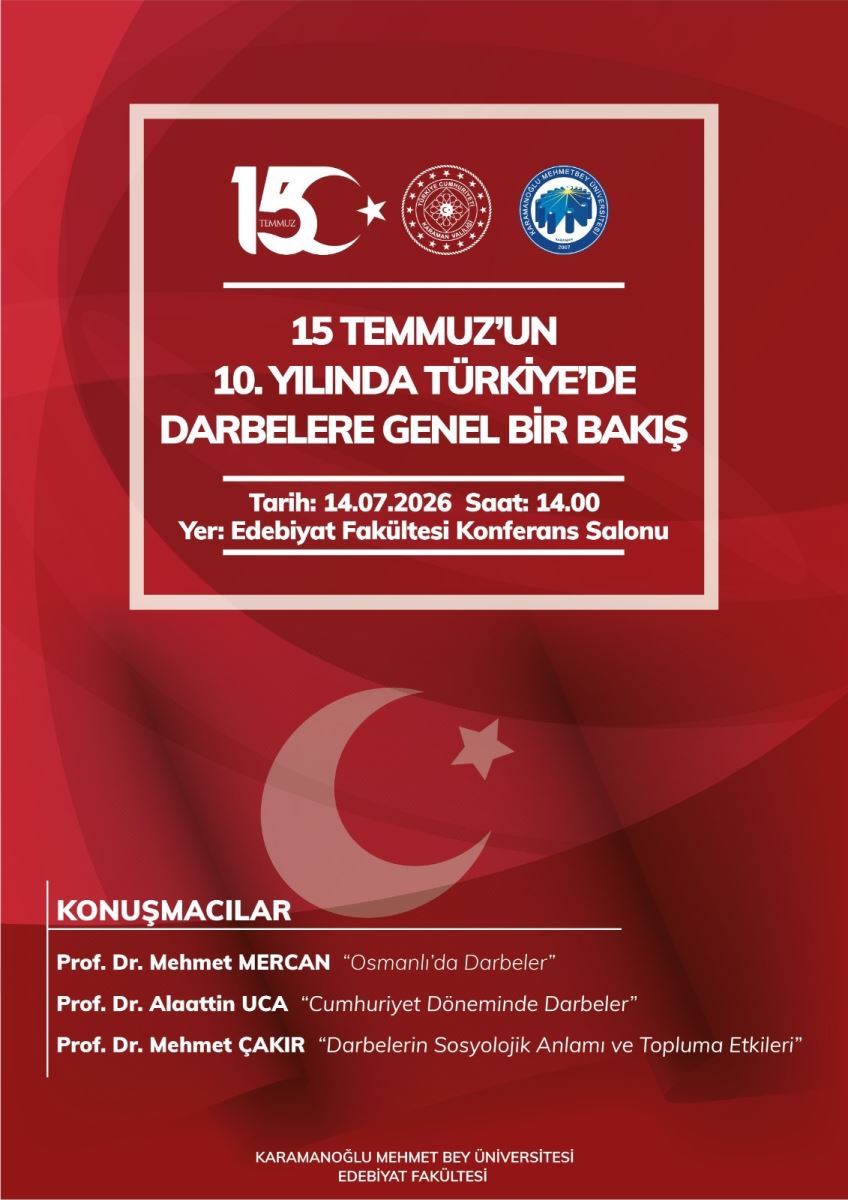
Organized by the Dean's Office of the Faculty of Letters at Karamanoğlu Mehmetbey University, the program titled "A General Overview of Coups in Türkiye on the 10th Anniversary of July 15" was held on 14 July 2026 in the Faculty of Letters Conference Hall. The event featured presentations by Prof. Dr. Mehmet Mercan and Prof. Dr. Alaattin Uca from the Department of History, and Prof. Dr. Mehmet Çakır from the Department of Sociology.
Delivering the opening presentation, Prof. Dr. Mehmet Mercan spoke on "Coups in the Ottoman Empire." He examined the historical development of the concept of coups and evaluated the succession struggles and changes of power that occurred during the Ottoman period. Referring to the Ottoman traditions of royal succession, Mercan discussed significant historical events, including the Buçuktepe Revolt, developments during the reign of Bayezid II, the deposition of Osman II, the Edirne Incident, the Patrona Halil Revolt, the dethronement of Selim III, the intervention of Alemdar Mustafa Pasha, the Kuleli Incident, and the coup against Sultan Abdülaziz. He emphasized that, although such changes in power were often legitimized in the Ottoman context, they were essentially attempts to seize political authority. Mercan concluded his presentation by expressing his hope for the uninterrupted continuation of democratic governance.
The second presentation, titled "Coups During the Republican Era," was delivered by Prof. Dr. Alaattin Uca. He defined a coup as the removal of an elected government through the use of force outside constitutional and democratic procedures. Explaining the distinction between a coup and a revolution, Uca provided a chronological overview of military interventions in the history of the Republic of Türkiye. His presentation covered the 27 May 1960 Coup, the 1962 Talat Aydemir Coup Attempt, the 12 March 1971 Military Memorandum, the 12 September 1980 Coup, the 28 February 1997 Process, the 27 April 2007 e-Memorandum, the 17–25 December 2013 process, the 15 July 2016 Coup Attempt, and the declaration issued by 103 retired admirals on 4 April 2021. He particularly emphasized that the 15 July coup attempt differed from previous military interventions because it was ultimately thwarted through the direct resistance of the Turkish people.
The final presentation, "The Sociological Meaning of Coups and Their Impact on Society," was delivered by Prof. Dr. Mehmet Çakır, who examined the social, political, and psychological consequences of coups from a sociological perspective. Çakır argued that coups extend far beyond changes in political leadership, leaving profound effects on collective memory, public trust, and perceptions of democracy. He noted that every coup develops its own strategy of legitimization and stressed that the 15 July coup attempt differed fundamentally from conventional military coups, as it was not carried out by the state as a whole but by an organized structure that had infiltrated state institutions. Highlighting the decisive role played by both the public and political leaders in resisting the coup attempt, Çakır also pointed to the importance of digital communication technologies in shaping the course of events. He concluded that the aftermath of 15 July contributed to significant transformations in democratic culture, political participation, and collective memory in Türkiye.
The program, which attracted considerable interest from participants, concluded with a question-and-answer session.
.jpeg)
.jpeg)
.jpeg)
.jpeg)
.jpeg)
Okunma sayısı: 94 kez okundu